The Art of Possibility
The Art of Possibility- By Rosamund and Benjamin Zander
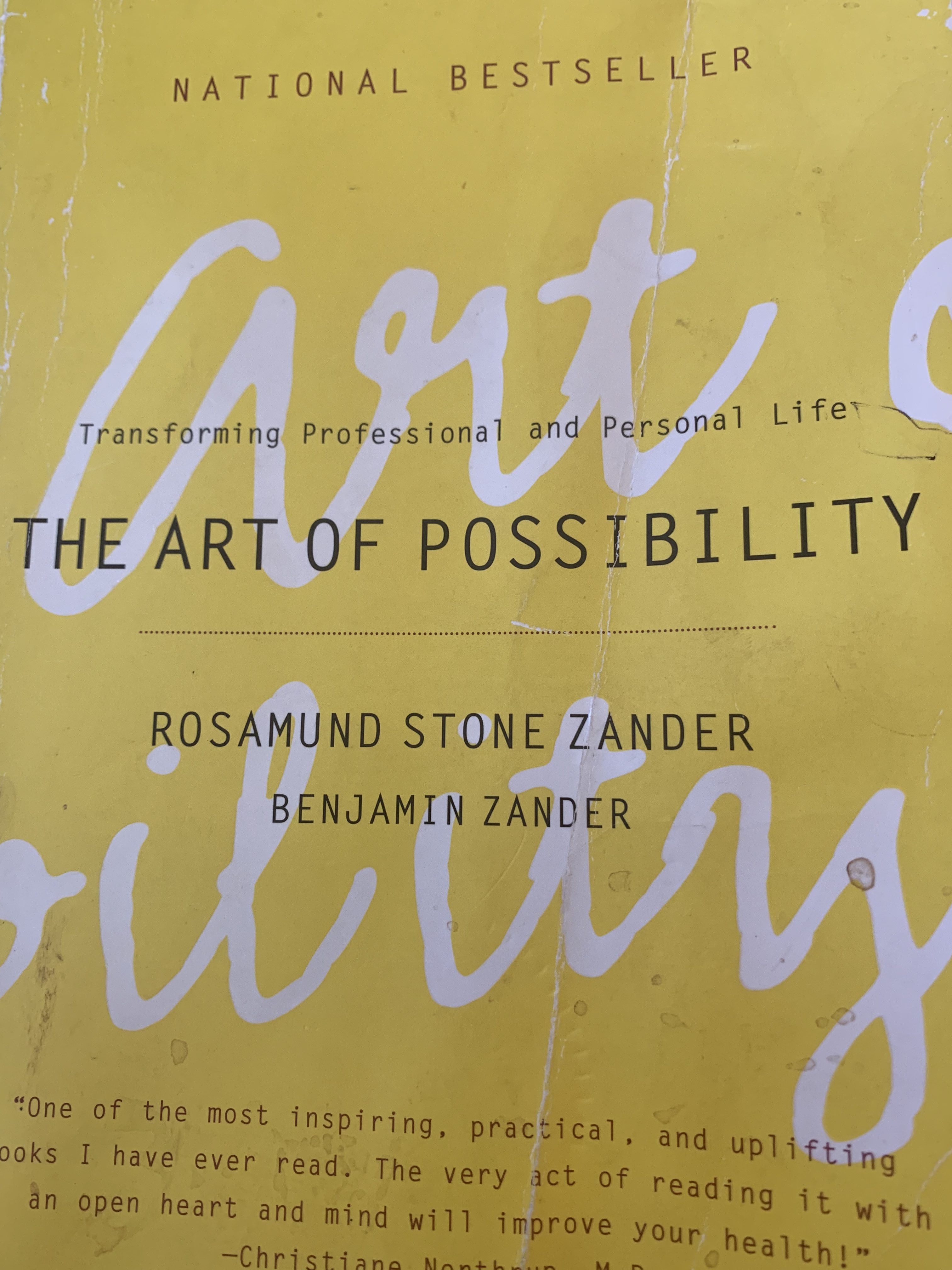
I was so inspired by reading this book that I have included short chapter synopses and my take-aways which I refer to as “nuggets.” Many of these nuggets are posed as questions. Formulating questions, and reflecting on them, has helped me sift through and reflect on the many powerful lessons and thoughts in this brilliant bright yellow book!
Chapter Highlights
I. It’s All Invented
We need to be careful with the “frames” we set up in our mind. They will determine what we believe is possible or not.
Nugget: Reflect on this scenario:
A shoe company sends two marketing scouts to a region in Africa.
One reported back: The situation is hopeless. No one wears shoes.
The other said : The business opportunity is great. They have no shoes.
II. Universe of Possibility
Finite parameters, like defined spaces, measurements and comparisons can constrain our behaviors and thoughts. Tackle life like as if it was a wide-open field , body of water, or blank canvas.
Nugget: Rather than setting a specific goal and striving for it, set the context for what you want and THEN let life unfold.
III. Giving an A+

When we give ourselves, and others an “A” grade at the onset, we allow for diverse perspectives and stop demanding outcomes to be delivered on our specific terms and conditions.
Nugget: A composer gives everyone in his class an A in the beginning of the course. The only required for the students is to write a letter explaining why they are deserving of it and it’s impact on them as a human being.
IV. Being a Contribution
Recognize that every action you take has a consequence and can inspire others to act as well.
Nugget: Ask yourself, your team, your class, and/or your children: How have you contributed in the past week?
V. Leading From Any Chair
Good leadership can be given from any chair. Be willing to give your front seat up and let others trade places with you.
Nugget: When was the last time you have literally or virtually passed out a blank sheet of paper and solicited feedback or questions to learn how you can be a better leader?
VI. Rule Number 6
Rule # 6 is Don’t take yourself so seriously. Learn the difference between your “calculating self” and your “central self” which has no judgments.
Nugget: Reflect upon this: What would have to change in my life for me to be fulfilled?
VII. The Way Things Are
Do not be resigned to just take things just as they are. Face the facts and then say, now what else is there for me? Learn to differentiate between nah-saying and being open to possibilities.
Nugget: Exchange an “AND” for a BUT.
Ex. We are in Florida for our winter vacation AND BUT it’s raining and so now we are able to catch up on our sleep, go to some great movies, and eat great food.
VIII. Giving Way to Passion
When we let go and release some of our control, we can become more spontaneous. And, become magnets for exciting change.
Nugget: What kind of powerful “conduit” can you be? Are you a conduit for music to flow? Are you a conduit for color to splash on canvas?
IX. Lighting a Spark
Have you “enrolled” someone else in the possibility of generating a spark? The way the authors use the word enrolling is not to be confused with guilting or bribing someone to look at something differently.
Nugget Have you looked at a situation and been clever about providing a solution/spark to make it better? The example in the book was centered around what resulted after they brought in an 80-piece orchestra to a school labeled as bleak and failing.
X. Being the Board

Taking responsibility for our actions vs. pointing the blame at others. Be willing to admit and share when we are wrong. The authors gave a great chessboard metaphor. Rather than being an individual piece on the board, like the knight, king, pawn, or the strategist, you become the actual board; framework from which the game is centered upon.
Nugget Ask yourself – How did this person or situation get on the board that I am on right now?
XI. Framework of Possibility
How can you create a vision that transforms your traditional guidelines even when others want you to act/discipline according to more “standard” protocols?
Nugget: Can you shift the language in how you address a situation to reflect additional opportunities for everyone involved?
XII. Telling the Story
How can we restructure our thinking so that ALL of us are successful? This is all about replacing the I … to We or US. How can we tell this story so that we are all connected and “OUR” dreams come true?
Nugget: Ask the questions: What will work for US? What shall WE do?
The Journey Begins
Thanks for joining me!
I dwell in possibility.
– Emily Dickenson

 Carolyn Keeney